A lot of readers on WPBeginner are web professionals, and one of the questions we recently received was: which is the best accounting software for web professionals? Working on your own business requires you to maintain your accounts, track earnings, expenses, taxes, invoices, and more. Luckily, there are some really great software that can help you streamline the process. In this article, we have hand-picked the best accounting software for small businesses and web professionals.

Why Use an Accounting Software?
When you’re just starting out, you can use a simple spreadsheet to manage your finances. However as your income and expenses grow, things get more complicated.
You will need to keep track of invoices, online payments, other income, expenses, and taxes. If you don’t streamline the process, then you will end up spending more time on these things and still not get them done properly.
An accounting software helps you easily keep track of your finances, manage invoices, do the bookkeeping, and help you calculate taxes. This helps you save a ton of time while enabling you to manage your money more efficiently.
That being said, let’s take a look at some of the best accounting software for web professionals, freelancers, and small businesses.
Best Accounting Software for Professionals
We will be looking at the top accounting software used by thousands of professionals around the world. Our goal is to highlight the ones that are easy to use, affordable, and offer the necessary features.
1. QuickBooks
QuickBooks is one of the most popular accounting software for web professionals and freelancers. You can easily connect it to your bank accounts, PayPal, and credit cards to automatically capture all your transactions.
It also allows you to send invoices to your customers and track them inside the app. Your customers can also directly pay by clicking on the payment button on their invoice.
QuickBooks make accounting easier for non-accountants. It comes with beautiful reports that give you a quick overview of your finances as well as detailed reports of all your expenses, earnings and invoices.
Another benefit of using QuickBooks is the ability to manage taxes. If you are using software like TurboTax, then QuickBooks can save you a ton of time when filing your taxes.
It comes with easy to use apps for mobile devices which allows you to capture receipts, manage finances, and view reports on the go.
Pricing: Small Business plans start at $10 / month, Self Employed plans start from $5 / month.
2. Godaddy Bookkeeping
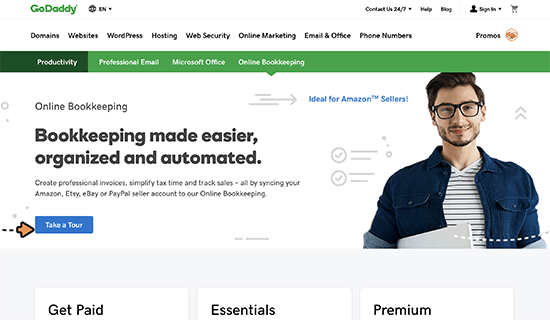
Most of you probably know GoDaddy as one of the biggest domain name registration companies in the world. However, they offer a ton of other services including a cloud-based bookkeeping software for small businesses.
GoDaddy Bookkeeping allows you to sync your bank, credit card, Amazon, Etsy, eBay or PayPal seller accounts to their bookkeeping platform. It then automatically tracks all your transactions and displays them with your total profit and loss report always visible on the top.
It also includes easy invoice management, with recurring invoices, and integrated payments via Stripe or PayPal. It is great for freelancers and small businesses who are looking for simpler bookkeeping solution however it lacks some advanced features that you will find in other apps on the list.
Pricing: Starting from $3.99 per month.
3. Freshbooks
FreshBooks is an ideal software for freelancers. It is one of the easiest apps to send and track invoices for freelancers and self-employed professionals.
It also allows you to track your expenses, capture receipts, manage projects you are working on, and accept payments from clients. It connects with your bank accounts to deposit payments directly.
There are beautiful reports inside the FreshBooks dashboard which makes accounting dead simple for everyone. It has a mobile app which gives you the freedom to see and manage things on the go.
Pricing: Starting from $15 / month.
4. Xero

Xero is another powerful web-based accounting software for professionals and small business websites. It offers plans and features that grow as your business needs grow.
Xero helps you easily send invoices, accept payments, view bank transactions, manage contacts, and more. You can create multi-currency accounts, manage payroll if you have employees, and even manage your projects within the app.
It offers a simple and easy to use interface with beautiful reporting tools. It is packed with a lot of features many of which you’ll probably never use as a freelancer, but you may need them as your business grows.
Pricing: Starter plan costs $9 per month, but it is too limited. You will need the standard plan which costs $30 per month.
5. Wave
Wave offers a free accounting software for small business. It allows you to easily manage all your finances by connecting your bank and credit card accounts to the app. It then tracks all your transactions and presents them in an easy to understand reports.
It also allows you to send manual, automatic, and recurring invoices. With the mobile app, you can capture receipts on the go and keep track of things from anywhere.
The basic software is free to use. However, there are transaction fees for credit card payments 2.9 % + 30 cents per transaction, and for ACH transfers 1% per transaction. If you have employees, then you should know that their payroll software is paid and not included in the free plan.
Pricing: free accounting software, transaction charges, and paid payroll software.
6. Zoho Books
Zoho is a well-known CRM software. With Zoho Books, they add professional accounting software to their suite of apps. The biggest advantage you’ll get by using Zoho is when you are using their CRM apps.
It connects well with other apps in their ecosystem as well as several payment gateways, bank accounts, and your credit cards. This allows you to completely automate your bookkeeping.
You can also share transactions with your customers by giving them access to their client portal. You can even enable Bulk payment feature to get paid faster by your clients.
Pricing: Starting from $9 per month.
Conclusion
If you’re looking for the most comprehensive solution, then we recommend using QuickBooks.
If you’re a small business owner who just wants a simple solution, then we recommend taking a look at GoDaddy Bookkeeping.
We hope this article helped you find the best accounting software for small businesses, professionals and freelancers. You may also want to see our article on best businesses phone services and best email marketing services for small businesses.
If you liked this article, then please subscribe to our YouTube Channel for WordPress video tutorials. You can also find us on Twitter and Facebook.
The post 6 Best Accounting Software for Small Businesses (Compared) appeared first on WPBeginner.
from: WPBeginner
via Editorial Staff
Source: 6 Best Accounting Software for Small Businesses (Compared) Via Business Advice.
Comments
Post a Comment