Got content marketing skills? I sure hope you do, because your work in content marketing will probably require all of them—and maybe even a few you don’t already have. Whatever skills you don’t have now, you can learn over time.
The skills I’d recommend a content marketer to have are:
1. The ability to learn (and learn fast)
Content marketing moves fast. If you don’t like change and can’t adapt quickly, you may never be happy as a content marketer. On the upside, if you like learning new things, you’ll find your curiosity to be a major competitive advantage. It’s a good idea to try to learn a new skill, or a new software project, or a new content marketing tactic every few months. Smart marketers are always evolving.
2. Writing skills
If you could pick just one skill to succeed as a content marketer, becoming a better writer might be it. Even if you’re able to hire content creators, you’ll still need editing skills, or the skills to write a strategy document or a press release. You also may need to write emails, job descriptions, or even captions in a pinch.
The following graph comes from a study of technology marketers, but look at how high writing skills are rated—they’re even above content marketing skills.

Image source: Spiceworks
3. Project management skills
Content marketing has a lot of moving parts. There’s the analytics, the content creation, the content promotion, the content reformatting, the coordinating with other departments, the coordinating with influencers and outside experts and freelancers . . . you get the idea.
4. People skills
“It’s all computer-based now.” Ever heard that?
Bupkes. People are still the alpha and omega of business—from the people you manage, the people who manage you, to customers, vendors, and everyone else you encounter. Being able to communicate and perhaps even persuade people is an essential skill. And if you’re managing people, being able to get everybody to play nice is a critical asset, too. You’re going to need it in your content marketing work.
5. Analytics skills
You don’t need to be a data scientist to run a content marketing department. But you do need to be able to look at detailed reports and see what’s really important amongst all those stats and numbers. And if you work in a small team, you may end up being the one who prepares those reports. According to research from Parse.ly and Ceros, “Digital media professionals are expected to have a facility with data.”
6. Search engine optimization
Many content marketers often struggle with their search engine optimization skills. They know they need them, but the technical aspect of SEO can make people think it’s harder than it really is.

Image source: Conductor
7. Speaking and presentation skills
You don’t necessarily need in-person presentation skills (though they certainly do help), but it is important to be well-spoken in a webinar or podcast interview, especially if you’re in B2B. It’s great to be able to say, “I’d love to do a webinar” or to be able to say yes to a podcast invite.
And, of course, if your company has a webinar program, it’s likely you’ll be the webinar host, unless you’re running a large content shop and can have a staffer take over the role of host or facilitator.
Other Articles From AllBusiness.com:
- 25 Frequently Asked Questions on Starting a Business
- 50 Questions Angel Investors Will Ask Entrepreneurs
- How to Create A Great Investor Pitch Deck for Startups Seeking Financing
- 17 Key Lessons for Entrepreneurs Starting A Business
8. Design
Okay, maybe you can get by without this—there are services that let you outsource a lot of design work for barely $15 an hour. But boy, it’s helpful to be able to make a decent-looking blog post header image, or to slap together some social media images in a pinch.
Another really handy complementary skill: data visualization. It’ll help you with your analytics work and with your design tasks.
9. Storytelling
An ability to tell stories can help you come up with the best content ideas, and also help you refine content you already have. Storytelling can help you weave different content projects together so your marketing has a consistency to it, rather than being a chunky, disparate series of campaigns.
10. Research
If you want to create exceptional content, you will need some research skills. That includes both being able to research content on the internet and being able to research what your audience thinks and wants. If you aren’t able to do good research, your content will have a shallow feel to it and won’t likely connect with your audience.
11. Social media
Ever set up a Facebook page? Got 1,000 or more followers on Twitter? Those are just the starting points of social media skills. Managing a content marketing social media program is in another league. You’re going to need first-rate social media skills if you want to your content marketing to hum.
12. WordPress
Almost every content marketing program has a blog. And pretty much every blog is run on WordPress, which means having WordPress skills is pretty much essential. You don’t have to be a WordPress whiz, of course, but being able to format, post, and schedule blog posts is important. And if you still need help, you can hire a service like WP Curve to outsource some of your work.
13. Email marketing
Email is one of the most widely used marketing tactics. In our own WASP Small Business survey, we found nearly half of all small businesses use it:
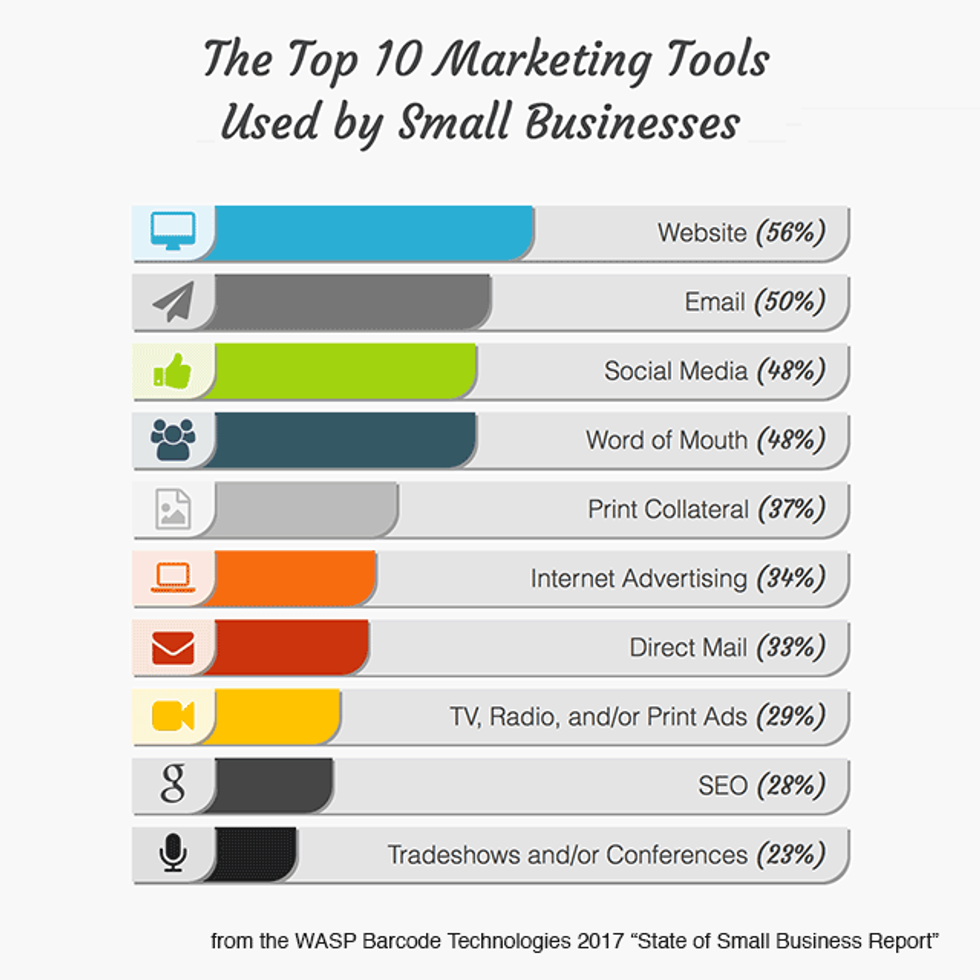
There’s a reason for this: Email works. It gets the highest or near the highest ROI of any tactic, and it’s affordable. You could study it your whole life, but you could also study it for a week or so, dive in, and refine your skills from there. Campaign Monitor offers a good basic introduction if you’re a total newbie.
14. Content promotion and distribution
Lordy, do most content marketers need some help with this one! Either they don’t know how to promote their content, or they don’t want to—or they just can’t find time for it. But most of the content published is grossly under promoted.
So how do you learn this skill? Get some social media advertising experience, for starters. Then learn the ins and outs of doing influencer outreach. And test to find out what works best for your particular content niche.
15. Strategy
I’ve saved the most important skill for last. But “strategy” may not really be the best way to describe this skill. Sure, strategy is important, but simply stating what you want to do and writing it down is not really a skill. A practice, yes—and a best practice.
The skill comes from being able to take analytics data, audience knowledge, industry knowledge, and business goals and hammer them into an actionable strategy. That’s where all these other skills come together.
RELATED: What 10 Years of Content Marketing Did for This Startup
The post 15 Essential Skills for Content Marketers—Do You Have Them? appeared first on AllBusiness.com
The post 15 Essential Skills for Content Marketers—Do You Have Them? appeared first on AllBusiness.com. Click for more information about Brian Sutter.
from: Sales & Marketing – AllBusiness.com
via Brian Sutter
Source: 15 Essential Skills for Content Marketers—Do You Have Them? Via Business Advice.
Comments
Post a Comment